How to properly use a disposable surgical blade
Disposable surgical blade is an essential cutting tool for surgical operations. It must be used together with a scalpel handle. Features: disposable & sterile, ultra-sharp blade, standard size coding.
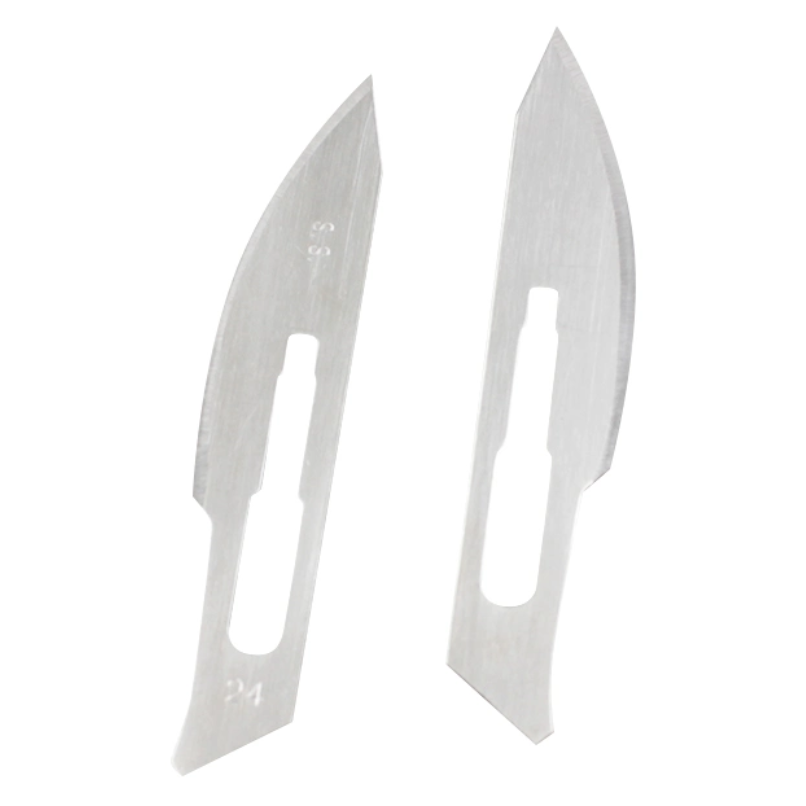
1. Material & Structure
Material: Made of carbon steel or stainless steel.
Carbon steel: higher sharpness, easy to rust.
Stainless steel: rust-proof and long service life.Medical grade blades are individually sterile packaged.
Structure: Each blade is equipped with a cutting edge and mounting slot, compatible with matched scalpel handles.
2. Common Models & Application
No.10: Large curved cutting edge, fits No.3 handle, used for long incisions on skin and muscle.
No.11: Sharp triangular tip, fits No.3 handle, applied for puncture incision, abscess drainage and vascular puncture.
No.12: Curved crescent-shaped edge, fits No.3 handle, used for tissue dissection in gynecology and orthopedics.
No.15: Small curved precision tip, fits No.3 handle, for delicate operations in ophthalmology, dentistry and plastic surgery.
No.22 / No.23: Large curved blades, fit No.4 handle, suitable for thick tissue and large incisions (e.g., abdominal and orthopedic surgery).
3. Scalpel Handle Matching Rules
No.3 Handle: Matches small-size blades including No.10/11/12/15 for precise surgery.
No.4 Handle: Matches large-size blades including No.20/21/22/23/24 for deep surgery and thick tissue cutting.
4. Usage & Safety Notice
Aseptic single use only to avoid cross infection.
Install and remove blades with needle holder; do not touch by bare hand to prevent injury.
Ultra-thin cutting edge saves cutting force and reduces tissue damage.
5. Application Range
Clinical use:Surgery, plastic surgery, ophthalmology, dentistry, obstetrics and gynecology.
Non-clinical use:Anatomy, laboratory, veterinary surgery, industrial cutting.
Previous:What is the usage of a CPAP