How Does a Nebulizer Mask Improve Aerosol Drug Delivery?
Effective aerosol drug delivery depends on more than the nebulizer itself. Particle size, driving gas flow, mask fit, tubing connections, and equipment compatibility all influence how aerosolized medication reaches the patient's respiratory tract. In this article, RTMED explains how Nebulizer Mask design supports aerosol therapy, what technical specifications matter, and how to select a suitable mask for hospital, clinical, and home-care applications.
Table of Contents
- How Does a Nebulizer Mask Support Aerosol Drug Delivery?
- Why Does Aerosol Particle Size Matter?
- How Do Mask Design and Components Affect Treatment?
- Which Nebulizer Devices Are Compatible?
- RTMED Nebulizer Mask Technical Specifications
- How Do We Control Product Quality?
- Where Are Nebulizer Masks Commonly Used?
- Frequently Asked Questions
How Does a Nebulizer Mask Support Aerosol Drug Delivery?
In respiratory therapy, delivering medication in aerosol form requires coordination between the nebulizer, tubing, and patient interface. A nebulizer converts liquid medication into small aerosol droplets, while the mask provides a pathway for the patient to inhale the generated aerosol through normal breathing.
At RTMED, we manufacture Nebulizer Masks for use with compatible aerosol nebulization systems. Our design focuses on several practical factors: a stable connection, an appropriate facial fit, a functional nebulizer chamber, and tubing that supports continuous gas flow.
Unlike a nebulizer compressor, the mask does not independently generate aerosol particles or determine the medication dose. Its role is to provide a suitable interface between the nebulizer assembly and the patient's respiratory tract. Poor connections, excessive facial leakage, or an unsuitable mask size can result in aerosol loss during treatment.
For this reason, we consider the complete delivery assembly rather than evaluating the mask by appearance alone. A properly matched nebulizer mask assembly helps establish a more consistent delivery setup when used according to the equipment manufacturer's instructions and the prescribed treatment procedure.
Why Does Aerosol Particle Size Matter?
Particle size is one of the important technical factors affecting aerosol deposition in the respiratory tract. Different droplet sizes tend to deposit in different airway regions. In general, particles within the approximately 1–5 μm range are commonly considered relevant for lower respiratory tract delivery, although actual deposition also depends on breathing patterns, device performance, medication properties, and patient conditions.
Our RTMED Nebulizer Mask product specifications list an atomization particle size of ≤5 μm. This parameter is relevant when evaluating the performance of the complete nebulization system. It should not be interpreted as a guarantee that every generated droplet will reach the lungs, because the nebulizer technology and operating conditions also influence the aerosol output.
| Technical Factor | Reference Information | Why It Matters |
|---|---|---|
| Aerosol Particle Size | Approximately 1–5 μm is commonly relevant for lower airway delivery | Influences where aerosol droplets may deposit in the respiratory tract |
| RTMED Atomization Specification | ≤5 μm | Provides a reference parameter for evaluating the nebulization assembly |
| Driving Gas Flow | Approximately 4–8 L/min | Affects aerosol generation when used with a compatible nebulizer system |
| Mask Fit | Appropriate facial coverage with controlled leakage | Helps reduce unnecessary aerosol loss around the mask |
From our manufacturing perspective, particle size should always be evaluated together with nebulizer output and operating conditions. For medical facilities, checking the performance of the complete system is more meaningful than relying on a single specification printed on the mask packaging.
For further technical information, readers can refer to the European Respiratory Society guidelines on nebulizer systems and the AARC Aerosol Drug Delivery Guide.
How Do Mask Design and Components Affect Treatment?
Mask structure influences how comfortably and consistently a patient can use a nebulization system. Even when the nebulizer produces the required aerosol, an unsuitable interface can lead to leakage, poor positioning, or interruptions during treatment.
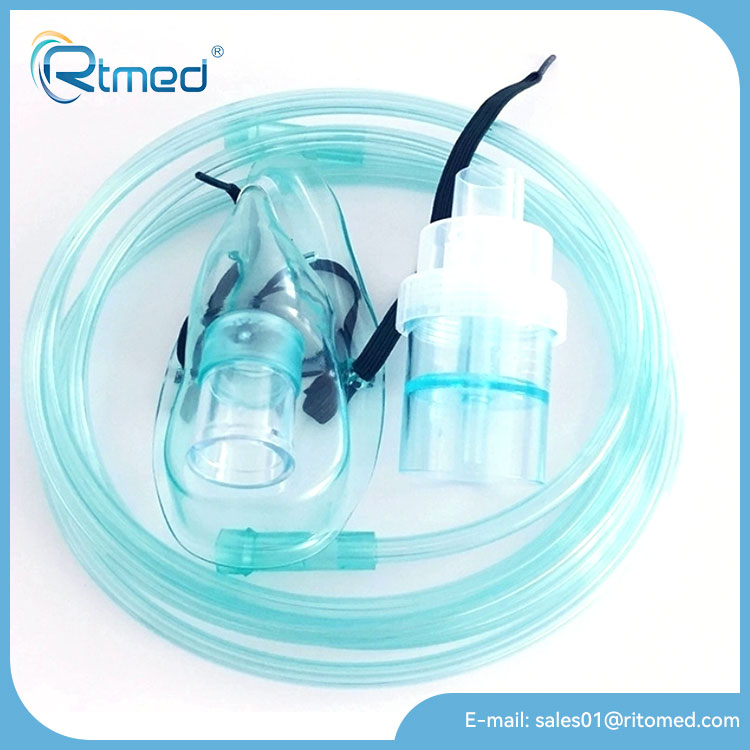
Our RTMED Nebulizer Mask includes several components designed for practical clinical and home-care use:
- Medical-grade PVC mask: The transparent mask body allows caregivers to observe positioning and check the visible condition of the mask during use.
- Adjustable nose clip: Helps improve positioning around the nose and accommodate different facial shapes.
- Elastic band: Supports mask positioning during treatment, particularly for patients who need assistance maintaining the correct fit.
- Nebulizer jar: Holds the prescribed liquid medication as part of the compatible nebulization assembly.
- Connecting tubing: Provides the gas pathway between the driving source and the nebulizer assembly.
We also offer four size options: S, M, L, and XL. This range helps medical facilities select an appropriate mask according to patient age, facial dimensions, and clinical requirements. A mask that is too large may create gaps around the cheeks, while one that is too small may cause discomfort or make positioning difficult.
For elderly patients and individuals with limited mobility, the elastic strap is particularly useful because it helps maintain mask positioning without requiring the patient to hold the mask continuously. However, correct adjustment and clinical supervision remain important.
Which Nebulizer Devices Are Compatible?
Device compatibility is an important consideration when hospitals and distributors source nebulizer accessories. Different nebulizer systems may use different connection arrangements, driving gas sources, and operating specifications.
Our RTMED Nebulizer Mask uses a universal-style standard connector intended for compatibility with most mainstream nebulizer equipment. Before purchasing in bulk, we recommend checking the connector dimensions and operating requirements against the intended equipment.
| Equipment Type | Typical Application | Compatibility Considerations |
|---|---|---|
| Compressor Nebulizers | Household respiratory therapy and clinical nebulization | Check air tubing diameter and connector fit. Common brands include Yuwell and Omron, subject to model verification. |
| Central Medical Oxygen Supply | Hospital wards and respiratory care departments | Requires a compatible oxygen-driven nebulizer assembly and appropriate flow regulation. |
| Medical Oil-Free Air Compressors | Hospital nebulization stations | Confirm gas output, connection dimensions, and the nebulizer's operating requirements. |
| Medical Oxygen Cylinders | Clinical settings with regulated oxygen supply | Requires a suitable pressure regulator and compatible nebulization equipment. |
One point worth emphasizing is that a universal-style connector does not mean every nebulizer model can be connected without verification. Medical facilities should confirm the actual interface dimensions and gas supply specifications before placing a large order.
RTMED Nebulizer Mask Technical Specifications
For distributors and medical equipment purchasers, clearly defined specifications make it easier to evaluate product compatibility, packaging requirements, and supply arrangements. The following table summarizes our RTMED Nebulizer Mask, model RT012-100.
| Item | Specification |
|---|---|
| Product Name | Nebulizer Mask / Aerosol Mask |
| Product Code | RT012-100 |
| Material | Medical-grade PVC; DEHP-free option available |
| Components | Mask, adjustable nose clip, elastic band, nebulizer jar |
| Connection Type | Universal-style standard connector |
| Available Sizes | S / M / L / XL |
| Tube Length | 2.1 m |
| Available Colors | Transparent White / Green |
| Nebulizer Volume | 6 cc / 8 cc |
| Atomization Particle Size | ≤5 μm |
| Driving Gas Flow | Approximately 4–8 L/min |
| Sterilization Method | Ethylene Oxide (EO) |
| Packaging | 1 pc/PE bag, 100 pcs/carton |
| Carton Dimensions | 50 × 39 × 35 cm |
| Production Lead Time | 25–35 days |
| Sample Policy | Free samples available |
| OEM Service | Private labeling and customized packaging available |
| Shipping Methods | Air freight, sea freight, FedEx, DHL, UPS, etc. |
How Do We Control Nebulizer Mask Quality?
For disposable medical consumables, quality consistency is just as important as product specifications. A mask may look similar to other products on the market, but connection strength, component assembly, material consistency, and packaging condition all deserve attention.
At Ningbo Rito Medical Instruments Co., Ltd. (RTMED), we focus on integrated manufacturing and quality checks throughout the production process. Our factory combines injection molding, product assembly, and packaging in a dust-free workshop, helping us manage production stages more efficiently.
We also conduct sampling inspections for each production batch and provide related COA documentation covering product appearance, connection firmness, and spray volume information. These records help our customers review batch quality and maintain their procurement documentation.
Our Nebulizer Mask production process generally includes the following stages:
- Material preparation: Prepare the specified PVC materials and production components.
- Injection molding: Manufacture the mask body and relevant plastic components according to the product specifications.
- Component assembly: Assemble the mask, nose clip, elastic band, nebulizer jar, and connecting parts.
- Sampling inspection: Check appearance, connection firmness, and relevant spray volume information.
- Sterilization and packaging: Complete the specified EO sterilization and packaging procedures.
- Final preparation: Check packing details and arrange shipment according to the confirmed order requirements.
RTMED's medical consumables portfolio also includes Oxygen Masks, Nebulizer Masks, medical tubes, infusion sets, wound dressings, and non-woven uniforms. This broader product range allows us to support customers sourcing multiple categories of medical consumables through one supply partner.
Where Are Nebulizer Masks Commonly Used?
Because nebulizer masks provide a face interface for aerosol inhalation, they are used in different healthcare environments where compatible nebulization equipment and prescribed inhalation medications are available.
- Hospitals: Used in respiratory care departments, general wards, and other clinical areas requiring nebulization equipment.
- Clinics: Supports aerosol therapy procedures in outpatient treatment settings.
- Emergency Departments: Used as part of compatible nebulization setups when aerosol medication is prescribed.
- Respiratory Therapy Departments: Provides a patient interface for routine nebulizer treatment.
- Home Care: Suitable for prescribed home nebulization when the patient uses compatible equipment and follows medical instructions.
- Medical Device Distributors: A disposable respiratory consumable for medical equipment supply portfolios.
For healthcare providers, the choice between a face mask and a mouthpiece should depend on the patient's ability to use the interface correctly, the prescribed medication, and clinical guidance. A face mask is not automatically the best option for every treatment. For example, certain inhaled medications require particular precautions to reduce unwanted deposition around the face and eyes.
Frequently Asked Questions About Nebulizer Masks
1. How does a nebulizer mask deliver aerosol medication?
A nebulizer converts liquid medication into aerosol droplets. The mask provides an interface through which the patient inhales the aerosol while breathing normally. Delivery depends on the nebulizer's performance, particle size, mask fit, and the patient's breathing pattern.
2. What particle size does the RTMED Nebulizer Mask support?
Our RTMED Nebulizer Mask product specification lists an atomization particle size of ≤5 μm. Actual aerosol particle distribution depends on the nebulizer assembly, gas flow, medication formulation, and operating conditions.
3. Is the RTMED Nebulizer Mask compatible with different nebulizer brands?
It uses a universal-style standard connector designed for most mainstream nebulizer equipment. However, we recommend confirming connector dimensions and operating requirements for the specific device model before bulk purchasing.
4. What sizes are available for this aerosol mask?
RTMED offers S, M, L, and XL sizes to accommodate different facial dimensions and patient requirements. The appropriate size should provide a comfortable fit with minimal leakage.
5. Can the Nebulizer Mask be reused?
No. Our RT012-100 Nebulizer Mask is a disposable medical consumable intended for single use by one patient. Reuse is not recommended because it may increase the risk of contamination and cross-infection.
6. Does RTMED provide OEM and customized Nebulizer Masks?
Yes. We support OEM services, including private-label packaging and customized tube lengths. Customers can confirm specifications, colors, artwork, and packaging requirements before sampling and mass production.
7. What quality documents can RTMED provide?
We provide related COA documentation based on batch sampling inspections, covering appearance, connection firmness, and spray volume information. Our company also holds CE and ISO 13485-related approvals for its medical product operations. Specific product certificates and applicable regulatory documents can be confirmed according to the product and target market.
8. What is the production lead time for RTMED Nebulizer Masks?
The standard production cycle for RT012-100 is approximately 25–35 days. Actual delivery schedules depend on order quantity, customization requirements, and production arrangements.
Conclusion
Effective aerosol drug delivery is a result of several connected factors, including nebulizer performance, particle size, gas flow, mask fit, and equipment compatibility. A well-designed Nebulizer Mask provides a suitable interface for transferring aerosol from the nebulization system to the patient, but its performance must always be considered as part of the complete treatment setup.
At RTMED, we combine medical consumables manufacturing experience with injection molding, assembly, batch sampling inspection, and OEM packaging services. With multiple mask sizes, a 2.1 m tube, 6 cc and 8 cc nebulizer volume options, and a standard connector design, our RT012-100 Nebulizer Mask is developed for hospital, clinic, and home-care supply applications.
As a medical consumables manufacturer and supplier based in Ningbo, China, we also provide Oxygen Masks, medical tubes, infusion sets, wound dressings, and non-woven uniforms. For product specifications, OEM requirements, or bulk order inquiries, contact RTMED to discuss your medical consumables sourcing needs.